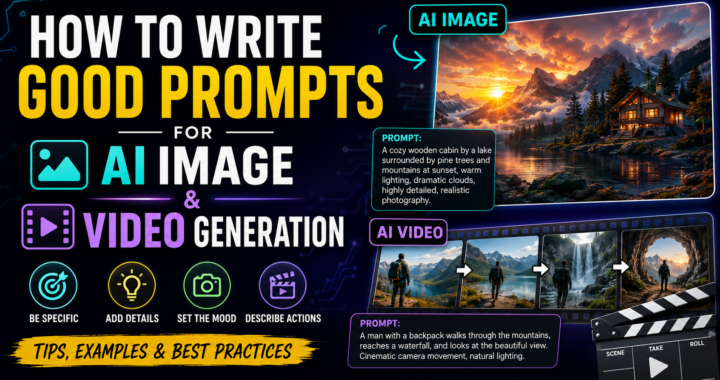

Prompting: The Skill of Talking to AI
Artificial intelligence is integrated into almost all walks of human life. ChatGPT, Gemini, Claude, and thousands of other AI-powered tools can help humans with various tasks, ranging from studying and writing to coding, designing, searching for information, and managing projects. However, there is one essential aspect of interacting with AI that determines how successfully one can use it: prompts.
A prompt is the instruction that tells the AI what to do. The art of writing prompts is called prompting. Prompting is not as straightforward as it might seem. If the instructions are vague, they may fail to deliver the expected result. The more information is provided to an AI, the higher the chances of receiving a satisfactory response will be.
This article is going to explore what prompting is, why it is important, and how one can write effective prompts. In addition, it is going to provide examples of prompts for different tasks, such as studying, writing, coding, and image generation.
What is Prompting?
Prompting refers to giving instructions to AI to perform desired actions. For example, if someone asks ChatGPT to “write about technology,” they can receive a response with information about virtually any topic related to technology. However, if one asks the AI to “write a 500-word article about the impact of artificial intelligence on education in simple words for high school students,” it will produce a better response, specifically targeting the needs of the given audience.
Therefore, it is essential to formulate requests properly to obtain the desired output. The process of prompting involves different techniques, including providing the AI with information, giving instructions, defining the format in which the response should be provided, specifying the limitations, describing the expected result, and other actions.
Why Prompting Is Important
In many cases, AI is indeed as smart as one expects it to be. Some users may wonder why their prompts do not yield satisfactory results when they try to, say, study for an exam or complete an assignment using AI. The reason lies in the fact that different prompts elicit different responses. Even if two users employ the same AI, they will receive different results because of their prompts.
For instance, if one asks an AI to “help study physics,” it may provide a rather generic response. A better option would be to provide the AI with more specific instructions, such as “explain electromagnetic induction for the class 12 student,” and define the format in which the response should be provided. The more guidance is given to the AI, the better result it will produce. After all, the user is going to be the one who will have to process the output and utilize it somehow.
The Basic Components of an Effective Prompt
There are several basic components that should be present in every prompt. Note that there is no universal set of rules that applies to all prompts, as different tasks require different approaches. With that said, some general guidelines may significantly enhance the effectiveness of prompting.
1. Define the Purpose
When prompting an AI, it is essential to be specific. Instead of asking “tell me about AI,” one should provide the AI with clear instructions, such as “explain what generative AI is, how it works at a fundamental level, and how it can be integrated into the daily lives of students.”
2. Provide the Necessary Context
Context is equally important, as it enables the AI to address the issue from the right perspective and respond to the exact request. For example, if someone asks the AI to “write an introduction,” it will produce a generic response suitable for none of the specific purposes. Instead, one should provide the AI with more context, such as the following prompt: “I am a class 12 student who wants to complete a school project on climate change. Write a simple introduction (approximately 150 words) that describes why climate change is important.”
3. Specify the Format
When prompting an AI, one should also specify the format in which the response should be provided. For instance, a prompt can look like this: “explain advantages of AI in education” followed by instructions “use 5 bullet points.”
Other examples include instructions to “create a comparison table between conventional and AI-based education” or “write the response in 3 paragraphs.”
4. Consider the Audience
When prompting an AI, it is essential to keep the target audience in mind. The level of detail and complexity will differ significantly depending on whether one is prompting for teenagers and college students or a group of professional researchers. In the former case, a more descriptive and detailed response should be provided, while in the latter case, one can ask the AI to use more technical terms.
An example of a prompt includes “explain quantum computing for someone who has little to no background in this field.”
Simple Prompts Versus Detailed Prompts
It is worth noting that not all prompts should be detailed. Very often, a simple request is sufficient to elicit a satisfactory response from an AI. For instance, one does not need to provide context and specify the format when asking the AI “what is photosynthesis?”
Sometimes, even simple prompts can provide excellent results. For instance, if a user asks an AI to “write about AI,” it can provide rather generic and satisfactory information on the topic.
However, if one intends to prompt an AI to write about a specific subject, more details may be required. For example, instead of asking the AI to “write a speech about AI,” one can provide the following prompt: “write a school speech about artificial intelligence for class 12 students. Speak about the benefits and risks of AI in education and try to keep the language simple. The speech should be approximately 3 minutes long and conclude with a short conclusion about how students can use technology responsibly.”
Prompting in Different Contexts
Prompting is a rather general term that encompasses a wide range of specific tasks. Here are some examples of prompting for different purposes.
Studying
Studying with the help of prompts can include a variety of tasks, such as asking the AI to explain difficult concepts, produce quizzes, provide chapter summaries, and much more. For instance, one can prompt an AI to “explain Newton’s laws of motion” and request additional questions for practice.
Writing
Prompting AI for writing-related tasks can be much more involved than prompting for studying purposes. There is a vast range of writing assignments, including articles, essays, speeches, and more. For example, one can ask an AI to write a 700-word article about the importance of cybersecurity in simple terms that a teenager can understand.
Code
Prompting AI for coding tasks can be highly beneficial, as it enables programmers to receive explanations, identify errors, and obtain functioning code. For example, one can ask an AI to explain a particular chunk of Python code line by line and identify potential errors. Again, the more context is provided, the better.
Image Generation
Prompting for image generation tasks is somewhat different, as it includes the specification of multiple attributes, such as the subject of the image, the background, the lighting, the perspective, the style, the color palette, and much more. For instance, one can request “a realistic image of a futuristic city at night with glass skyscrapers, flying cars, neon signs, and people walking around.”
Iterative Prompting: How to Get Better Results
Many novice prompters make a common mistake of expecting the AI to provide satisfactory results from the first attempt. Most often, such attempts are unsatisfactory because the prompter did not provide enough context or guidance. If one receives an unsatisfactory response, it should be possible to iterate: rephrase the prompt, specify the requirements, and ask the AI to revise the response.
For example, if one asks an AI to “write an article about social media” and receives a rather generic response that fails to target a specific audience, it is possible to rephrase the prompt as “revise the article about social media for class 12 students. Focus on the impact of social media on education, communication, well-being, and privacy. Keep the language simple and speak about real-life applications.”
The iterative prompting approach involves the continuous cycle of prompting, evaluating the response, and iterating until satisfactory results are achieved. In my opinion, this is the most important part of prompting because it allows the prompter to gain more control over the process. One does not have to be perfect from the first attempt.
Common Prompting Mistakes
There are certain mistakes that prompters tend to make when interacting with AI. First, some users fail to provide sufficient context. In addition, some users add irrelevant information that does not contribute to the prompt in any way. In many cases, users also forget to specify their requirements. Another common mistake is believing in all information provided by AI.
It should be noted that AI can provide false or outdated information. It is vitally important to corroborate vital information with other sources.
Prompting is Becoming an Essential Skill
Over the years, AI has become an integral part of human life. It is used in diverse fields, ranging from education and marketing to management and coding. However, the success of AI utilization depends on the ability of humans to communicate with it effectively. It is not as difficult as it seems. In fact, effective prompting is similar to requesting information from another person. One has to be able to clearly define the topic, provide relevant context, specify the desired outcome, define the format, and describe other requirements.
Conclusion
Prompting is an essential skill that helps people achieve more by interacting with powerful AI systems. It is relatively straightforward; thus, it can be mastered by almost everyone. When used correctly, prompting can yield impressive results regardless of the task. For instance, when studying for an exam, one can request the AI to generate practice questions, while a writer can ask the AI to help revise a complex article.
The most critical aspects of prompting include clarity, context, specificity, and iterativity. As long as these principles are followed, one can receive satisfactory results. After all, prompting is the art of asking for help in such a way that AI knows exactly what one needs.