
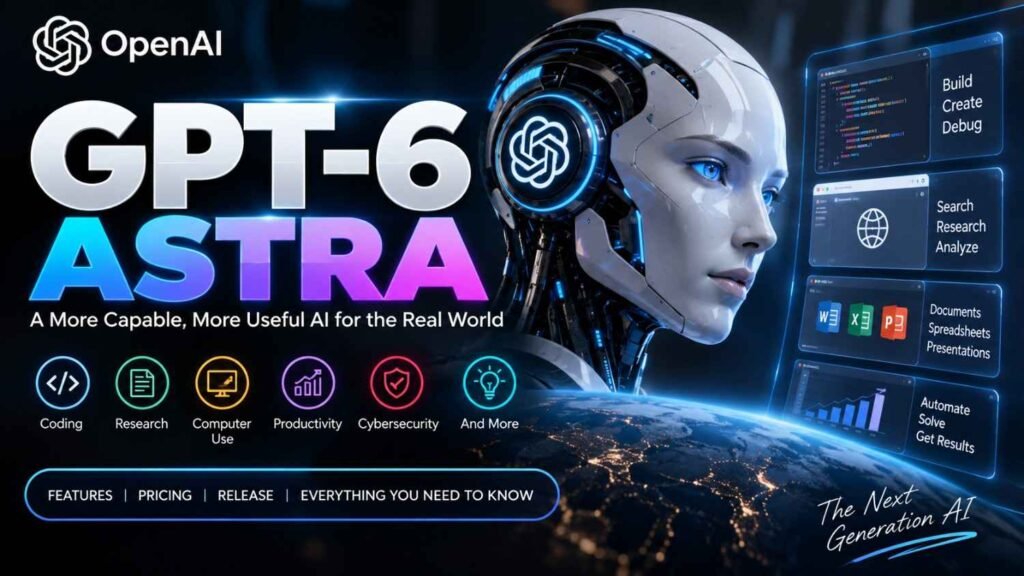
GPT-6 Astra: Features, Pricing, Release and Everything You Need to Know
Artificial intelligence is moving beyond chatbots that simply answer questions. Modern AI systems can reason through complex problems, use software, interact with computers, write code, conduct research and complete multi-step workflows.
GPT-6 Astra is OpenAI’s flagship model built around this next stage of AI. OpenAI describes it as its most capable model for difficult end-to-end work, with capabilities covering computer use, browsing, software engineering, cybersecurity, science and professional tasks.
The model is designed to combine advanced reasoning with tools and computer interaction. This allows it to work on tasks that previously required users to manually handle many individual steps.
So, what exactly can it do, how much does it cost, and who can access it? Here’s everything you need to know.
Image suggestion: Futuristic AI assistant working across a computer, browser, documents and software applications.
What Is GPT-6 Astra?
GPT-6 Astra is OpenAI’s flagship AI model for complex reasoning and end-to-end tasks.

OpenAI’s API documentation describes the model as being designed for difficult work involving reasoning, coding, computer use, research and document creation. It supports reasoning effort from low through max and has a context window of 1.05 million tokens, with a maximum output of 128,000 tokens.
The important difference is not simply that the model can generate sophisticated text.
It is designed to work through a complete task.
For example, a user could ask an AI to research a topic, organize the information, create a spreadsheet and prepare a presentation. An advanced agent can potentially handle several of those steps using the appropriate tools rather than requiring the user to manually direct every action.
This makes the system particularly interesting for developers, researchers, businesses and professionals.
Computer Use and Automation
One of the biggest developments in modern AI is the ability to interact with computer environments.
Instead of merely telling a person where to click, an AI agent can potentially interact with websites and applications itself. This can include navigating pages, entering information, working with documents and completing repetitive digital workflows.
Potential applications include:
- Online research
- Form filling
- Spreadsheet work
- CRM updates
- Calendar organization
- Software testing
- Website quality assurance
- Document formatting
- Repetitive computer tasks
The important difference is that the AI is not limited to producing text. It can potentially become an active participant in the workflow.
Image suggestion: AI agent interacting with a browser, spreadsheet and business applications.
GPT-6 Astra for Coding
Software engineering is another major area where GPT-6 Astra is designed to help.
Writing code is only one part of software development. Developers also need to understand requirements, inspect existing code, run applications, investigate errors, test changes and verify that the final result works correctly.
OpenAI lists software engineering among the areas where the model delivers strong performance.
A typical AI-assisted development workflow can involve:
- Understanding the requirements
- Planning the implementation
- Writing or modifying code
- Running the application
- Identifying errors
- Debugging problems
- Testing functionality
- Reviewing the final result
This approach is different from simply asking an AI for a code snippet.
The system can potentially participate in a much larger portion of the development process.
For developers, this could reduce time spent on repetitive coding and debugging. For beginners, it could make it easier to turn an idea into a working prototype.
Website and App Development
Website development is another practical application of advanced AI.
OpenAI says its Sites capability can create, host and share websites, web applications and games directly from a prompt. The model also has stronger visual judgment for websites, applications, games and other renderings.
This could be useful for both beginners and experienced developers.
A beginner could describe the website they want to create, while an experienced developer could use AI to speed up implementation, testing and debugging.
Potential tasks include:
- Creating page layouts
- Building frontend components
- Writing JavaScript
- Developing interactive features
- Debugging websites
- Testing user interfaces
- Creating prototypes
- Building web applications
The result is a development workflow where humans can concentrate on requirements and product decisions while AI handles more of the technical execution.
Image suggestion: AI building and testing a modern responsive website inside a development environment.
Professional Work and Productivity
Another major focus of GPT-6 Astra is professional work.
The model is designed to create documents, spreadsheets, presentations and analyses while following existing templates, instructions and visual styles.
This is important because professional work often depends on predefined formats.
For example, a company may have a specific presentation template, reporting structure or spreadsheet format. Instead of creating something unrelated, an AI system can work within those requirements.
Potential applications include:
- Business reports
- Presentations
- Spreadsheet analysis
- Data analysis
- Research reports
- Document creation
- Project planning
- Professional workflows
- Business automation
The system can also adapt when requirements change during a task, which is particularly useful for long-running workflows.
Science and Research
Scientific research often requires a combination of reasoning, programming, data analysis and specialized software.
GPT-6 Astra is designed to combine scientific reasoning with computer use, allowing it to work with specialized tools to inspect data and explore results.
Potential research applications include:
- Data analysis
- Mathematical exploration
- Scientific programming
- Research assistance
- Dataset processing
- Visualization
- Investigating possible solutions
- Reviewing technical information
OpenAI has published benchmark results showing strong performance in mathematical and general reasoning evaluations.
Benchmark results should still be interpreted carefully. They measure performance under particular testing conditions and do not mean that an AI system is automatically better than humans at every real-world task.
Cybersecurity Capabilities
Cybersecurity is one of the most significant and sensitive areas of advanced AI.
OpenAI says the model has reached the Critical level of cybersecurity capability under its Preparedness Framework. With appropriate tools and access, it can identify previously unknown security weaknesses and develop new exploitation techniques.
These capabilities could be valuable to security professionals.
Defenders could potentially use advanced AI to identify weaknesses, analyze software and improve security before vulnerabilities are exploited.
However, the same capabilities could also create risks if misused.
OpenAI says it has strengthened protections around the model, including additional monitoring and security measures designed to reduce harmful cyber actions and address potential misalignment.
This makes cybersecurity both an important application and an important safety challenge for advanced AI.
Context Window and API
For developers, GPT-6 Astra is available through the OpenAI API using the model identifier:
gpt-6-astra
The API documentation lists a 1,050,000-token context window and a 128,000-token maximum output.
A large context window can be particularly useful for applications that need to process substantial amounts of information.
Examples include:
- Large codebases
- Long documents
- Research material
- Complex project instructions
- Large datasets
- Multi-step workflows
Developers can therefore build applications where the AI has access to much more context before generating its response.
Pricing
According to OpenAI’s API documentation, standard pricing includes:
- Input: $10 per 1 million tokens
- Cached input: $1 per 1 million tokens
- Cache writes: $12.50 per 1 million tokens
- Output: $50 per 1 million tokens
OpenAI also states that prompts exceeding 272,000 input tokens are subject to higher rates for the full request.
The final cost depends on how much information an application sends and how much output it generates.
For developers, prompt caching and efficient workflow design can therefore have a major effect on overall costs.
Availability
OpenAI announced the rollout of GPT-6 Astra in September 2026.
The company said it would initially roll out to a limited group of organizations before becoming available more broadly to ChatGPT Plus, Pro, Business and Enterprise users. API access is also available, along with availability through cloud platforms.
OpenAI’s release information indicates that access is being rolled out in phases rather than becoming universally available at the same moment.
For developers, the API version can be accessed using the gpt-6-astra model ID.
Availability and limits can vary depending on the product and account, so users should check the latest OpenAI documentation before planning a production application.
Is GPT-6 Astra AGI?
The capabilities of modern AI models have renewed discussion around Artificial General Intelligence, or AGI.
There is no universally accepted definition of AGI.
Generally, the term describes an AI system capable of performing a broad range of intellectual tasks rather than being limited to a specific narrow function.
The model’s capabilities across reasoning, coding, computer use, science and professional work make it an important development in that direction.
However, whether it should actually be classified as AGI depends on the definition being used.
It is more useful to examine what the system can reliably accomplish than to focus solely on the AGI label.
How It Differs From Traditional Chatbots
The difference can be explained with three simple workflows.
Traditional Chatbot
Question → Answer
The user asks something and the AI responds.
Reasoning Model
Complex problem → Reasoning → Solution
The AI spends more effort working through a difficult problem before responding.
Agentic AI
Goal → Planning → Tool use → Computer interaction → Testing → Corrections → Completed task
This third approach represents the biggest change.
The AI is no longer limited to generating information. It can potentially become an active participant in the workflow.
Humans still play an important role by setting objectives, defining permissions, reviewing results and making important decisions.
Who Can Benefit From It?
The potential applications cover many types of users.
Students
Students can use advanced AI for explanations, research assistance, programming practice, presentations and learning difficult concepts.
Developers
Developers can use it for coding, debugging, testing, documentation, website development and software research.
Businesses
Companies can use AI for reports, presentations, spreadsheets, research, data analysis and repetitive computer-based workflows.
Researchers
Researchers can use it for scientific data analysis, programming, mathematical exploration and research assistance.
Content Creators
Creators can use advanced AI for website development, applications, research, presentations and digital production.
Security Professionals
Authorized security teams can use AI for defensive research, vulnerability analysis and security testing.
Advantages and Limitations
The biggest advantage is the combination of intelligence with action.
The system can reason about a problem and potentially use tools to work toward a solution.
Other advantages include:
- Advanced reasoning
- Computer interaction
- Large context capacity
- Coding assistance
- Research capabilities
- Professional document creation
- Multi-step workflow support
However, advanced AI is not perfect.
It can still misunderstand instructions, make incorrect assumptions, generate inaccurate information or fail to complete a task properly.
These problems become more important when an AI can take actions.
A wrong answer from a chatbot might waste someone’s time. An incorrect action performed by an AI agent could potentially change data or affect an important workflow.
Privacy is another consideration. Users should be careful when giving AI access to confidential documents, sensitive accounts or private company systems.
Human oversight therefore remains important, especially for high-impact tasks.
The Future of AI Agents
The development of advanced AI models points toward a future where users increasingly provide AI systems with goals instead of individual instructions.
Today, a user might need to say:
“Search these websites, collect the information, put it into a spreadsheet, analyze the results and prepare a report.”
A future workflow could potentially be simplified to:
“Prepare a detailed comparison of these companies.”
The AI could then determine the necessary steps and use available tools to complete the work.
This could change how people interact with computers.
Instead of manually operating every application, users may increasingly use AI as an interface between themselves and software.
That does not mean humans become unnecessary. Instead, human work may shift toward planning, judgment, creativity, verification and decision-making while AI handles more repetitive execution.
Image suggestion: Human working alongside an AI agent that manages multiple digital tasks.
You can check out this for Chat GPT Prompts – Click Here
Final Thoughts
GPT-6 Astra represents an important development in the evolution of artificial intelligence.
Its significance is not simply that it can produce better text. The bigger change is the combination of reasoning, computer use, coding, research and multi-step task execution.
OpenAI’s published evaluations show major advances across computer use, mathematics, cybersecurity, browsing and professional workflows.
At the same time, these capabilities highlight why reliability, privacy, security and human oversight are becoming increasingly important.
As AI systems become capable of doing more work independently, the relationship between people and computers could change significantly.
The most important question may no longer be:
“What can AI tell me?”
Instead, it may be:
“What can AI actually do for me?”
That shift from AI that simply answers questions to AI that can help complete real-world work could define the next major chapter of artificial intelligence.
Frequently Asked Questions
What is GPT-6 Astra?
GPT-6 Astra is OpenAI’s flagship model for difficult end-to-end work involving reasoning, coding, computer use, research and professional workflows.
What can it do?
It can assist with coding, research, browsing, computer use, document creation, spreadsheets, presentations, scientific workflows and other complex tasks.
What is the API model name?
The API model identifier is gpt-6-astra.
How much does it cost?
OpenAI lists standard API pricing at $10 per million input tokens and $50 per million output tokens, with separate cache pricing.
What is the context window?
The model has a context window of 1.05 million tokens and supports up to 128,000 output tokens.
Is it available in ChatGPT?
OpenAI announced availability for Plus, Pro, Business and Enterprise users as part of its phased rollout, in addition to API and cloud-platform access. Availability can vary by account and product.
Is it AGI?
There is no universally accepted definition of AGI. Its broad reasoning, coding, computer-use and research capabilities represent a significant development toward increasingly general-purpose AI, but the AGI classification depends on the definition being used.
Is it useful for coding?
Yes. Software engineering is one of the primary areas for which the model is designed, including complex development workflows.

[…] You may Also Read: GPT-6 Astra: Features, Pricing, Release & More […]
[…] the ChatGPT plan. In particular, GPT-5.6 Sol is used for Medium, High, and Extra High reasoning in ChatGPT, while GPT-5.6 Sol Pro is available for the Pro […]