
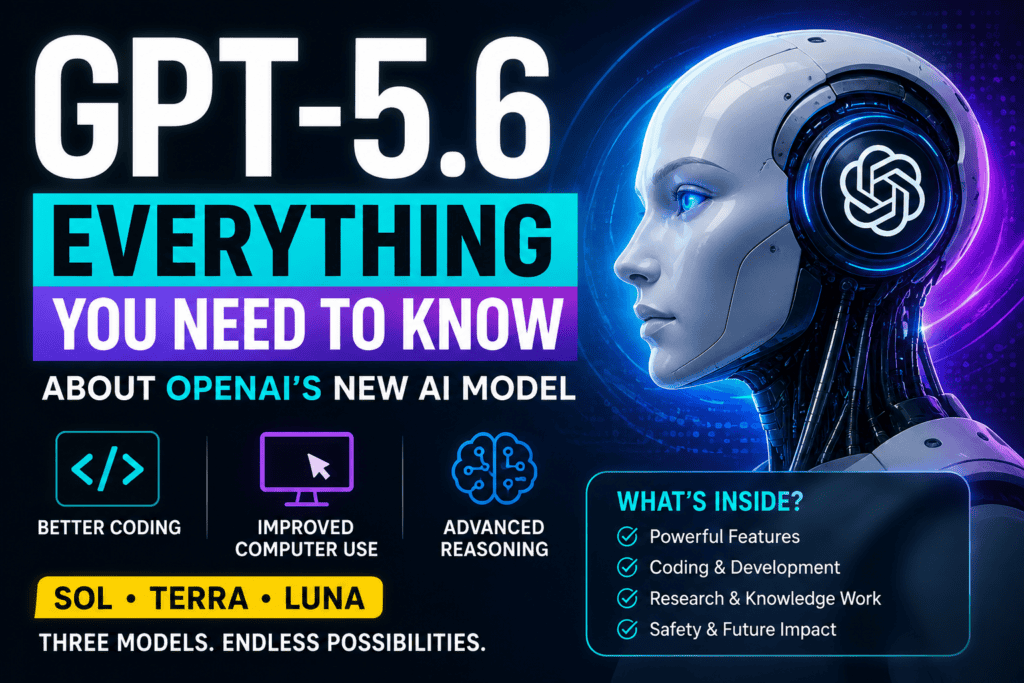
GPT-5.6: Everything You Need to Know About OpenAI’s New AI Model
Artificial intelligence is progressing rapidly, and OpenAI is at the forefront of innovation, introducing new AI models that excel in various domains. In July 2026, OpenAI announced the GPT-5.6 series, a family of advanced language models capable of performing tasks ranging from simple chats to complex coding, research, science, cybersecurity, and intricate computer operations.
The GPT-5.6 series consists of three variants: GPT-5.6 Sol, GPT-5.6 Terra, and GPT-5.6 Luna. Each variant offers different levels of reasoning, speed, and cost-effectiveness to cater to diverse needs. GPT-5.6 Sol is the flagship model, while GPT-5.6 Terra provides a balance between performance and affordability, and GPT-5.6 Luna is the fastest and most cost-effective option.
What Is GPT-5.6?
GPT-5.6 is the latest generation of artificial intelligence models developed by OpenAI. These models are designed to execute tasks that require reasoning, planning, coding, research, computer use, and design.
GPT-5.6 Sol is the leading model, intended for sophisticated professional and technical applications. OpenAI positions it as their flagship reasoning model for coding, knowledge work, research, cybersecurity, science, computer use, and design.
It is essential to recognize that GPT-5.6 is not a singular model but a series of models that provide different levels of capabilities.
The three variants are:
- GPT-5.6 Sol – The flagship model for complex tasks
- GPT-5.6 Terra – The balanced model for value
- GPT-5.6 Luna – The fastest and most affordable model in the GPT-5.6 series
This way, developers and users can choose between a powerful but expensive model, a balanced model, or a fast and affordable model depending on the task at hand.
GPT-5.6 Sol: The Main Model
GPT-5.6 Sol is the most capable model in the series and is suitable for the most demanding applications. It is intended for tasks that require higher accuracy, reasoning, and complex problem-solving than quick responses.
GPT-5.6 Sol can be applied in programming, research, science, cybersecurity, professional knowledge work, design, and computer use.
One of the most notable upgrades in GPT-5.6 is enhanced reasoning, specifically the ability to perform tasks that require extensive planning and execution. Instead of executing relatively simple tasks, the model can engage in multi-step processes, including using various tools and analyzing intermediate results.
This makes GPT-5.6 Sol particularly valuable for AI agents and coding assistants, where the AI has to inspect files, write and execute programs, identify and resolve issues, and perform other tasks.
Better Coding and Software Development
One of the most significant improvements in GPT-5.6 is its coding and software development capabilities. According to OpenAI, GPT-5.6 Sol is their best coding model yet, with state-of-the-art performance on coding benchmarks such as Terminal-Bench 2.1 and DeepSWE, which involve complex software-engineering and command-line operations.
This means that GPT-5.6 can be used for more involved coding tasks than ever before.
For instance, developers can use GPT-5.6 to construct applications from natural language queries, debug code, explain concepts, work with large-scale software, write tests, analyze errors, refactor code, execute commands, and plan development processes.
The critical insight is that AI coding assistants are becoming more agentic: Instead of simply providing code snippets or responding to queries, they can now perform multiple actions and analyze intermediate results.
Improved Computer Use
GPT-5.6 has stronger computer-use capabilities, an essential upgrade, as AI assistants are often limited by their interactions with computers.
While traditional AI models work with text, code, or images, more advanced models interact with computers more directly and utilize tools to perform tasks.
According to OpenAI, GPT-5.6 has stronger computer-use capabilities and can inspect and refine results rather than simply generating the underlying code or content.
This way, GPT-5.6 can be applied to building websites, working with software, testing programs, and executing other tasks that involve computers.
For instance, an AI assistant can generate a website, analyze the results, identify problems, and attempt to resolve them automatically instead of simply generating HTML and CSS code.
GPT-5.6 and Design
An intriguing application of GPT-5.6 is in design, as the model has stronger design judgment and can generate better interfaces from high-level instructions.
According to OpenAI, GPT-5.6 can create more aesthetically pleasing, functional, and accessible interfaces from natural language instructions and analyze the results to refine the design.
This means that GPT-5.6 can be used to build websites and applications with better layouts, more intuitive interactions, and improved overall user experiences.
While professional designers will likely continue to play a critical role in most design tasks, GPT-5.6 can benefit anyone who wants to create interfaces but does not have extensive design experience.
It is worth noting that AI-generated design should be reviewed by humans, as the model may not fully incorporate accessibility, usability, branding, and other considerations.
GPT-5.6 for Research and Knowledge Work
GPT-5.6 can be applied to research and knowledge work, as it can process unstructured information from various documents and digital tools and produce structured, easily digestible formats.
This way, the model can be used for research, documentation, reports, data analysis, business analysis, planning, technical writing, and similar tasks.
For instance, students, researchers, developers, and businesses can use GPT-5.6 to perform various repetitive information-processing tasks.
However, it is essential to remember that GPT-5.6, like any other AI model, is not perfect, and its results should be double-checked, especially when it comes to factual information.
GPT-5.6 in ChatGPT
GPT-5.6 is available in ChatGPT, but the specifics may vary depending on the ChatGPT plan. In particular, GPT-5.6 Sol is used for Medium, High, and Extra High reasoning in ChatGPT, while GPT-5.6 Sol Pro is available for the Pro plan.
At the same time, GPT-5.5 Instant is the default option for quick chats.
Therefore, it is possible that a user will not see GPT-5.6 in their ChatGPT experience, as the model has to be selected explicitly in the reasoning settings.
Moreover, OpenAI notes that the availability of GPT-5.6 is rolling out gradually, so even if a user has access to GPT-5.6, they may not see it right away.
GPT-5.6 for Developers
Developers can use GPT-5.6 through the OpenAI API. The API includes all three variants of GPT-5.6, so developers can choose between Sol, Terra, and Luna depending on their needs and budget.
In particular, developers can use GPT-5.6 to build AI assistants, coding agents, customer-support chatbots, research tools, business-process automation systems, websites with AI capabilities, data-processing applications, and other computer programs.
Notably, GPT-5.6 can be used to build more sophisticated agents that perform multiple tasks, including using various tools and analyzing results.
GPT-5.6 Safety
With the increased capabilities of GPT-5.6, the safety features are also paramount. According to OpenAI, GPT-5.6 has safety measures to prevent the model from engaging in certain high-risk biological and cybersecurity research.
The company has also emphasized that GPT-5.6 Sol will have enhanced safety features, including additional testing and automated red-teaming to identify and address potential issues before the model is deployed.
The safety features are particularly important, given that more advanced models can be used for both beneficial and harmful purposes.
Is GPT-5.6 Better Than GPT-5.5?
GPT-5.6 is generally better than GPT-5.5, as it is a more advanced model that is better at reasoning, coding, computer use, research, and other complex tasks.
According to OpenAI, GPT-5.6 Sol has stronger performance across a variety of benchmarks, including professional knowledge work and coding, while also being more efficient.
However, it is essential to remember that “better” is a relative term and depends on the use case.
A faster model such as GPT-5.5 Instant may be more suitable for simple tasks, while GPT-5.6 Sol may be better at complex tasks that require extensive reasoning.
GPT-5.6: What Does It Mean for the Future?
GPT-5.6 represents a paradigm shift in AI development, as the focus is no longer on building better chatbots but on creating AI assistants and agents that can reason, code, research, design, use computers, and perform other tasks.
For developers, this means more powerful coding assistants, while businesses can leverage such models to automate various processes and perform research.
At the same time, regular users can benefit from an AI assistant that can perform a wide range of tasks, from simple chats to complex programming.
However, it is essential to remember that AI is a tool, and more capable models still require human oversight.
In particular, users should be wary of trusting AI-generated information, especially when it comes to financial, legal, medical, and other sensitive areas.
Final Thoughts
GPT-5.6 is a significant update to OpenAI’s large language model, and the changes affect almost every domain. Unlike previous iterations of GPT, which were primarily focused on improving chatbots, GPT-5.6 is all about reasoning, coding, research, computer use, design, and agents.
The GPT-5.6 series includes three variants: GPT-5.6 Sol, GPT-5.6 Terra, and GPT-5.6 Luna, which cater to different needs.
GPT-5.6 Sol is the most powerful model that is suitable for complex tasks, while GPT-5.6 Terra offers a good balance between performance and cost, and GPT-5.6 Luna is the fastest and most affordable option.
As such, GPT-5.6 is a must-watch for anyone who is interested in AI development, software engineering, automation, and related fields.