
7 Powerful Facts About Jev by TypeSafe AI You Should Know
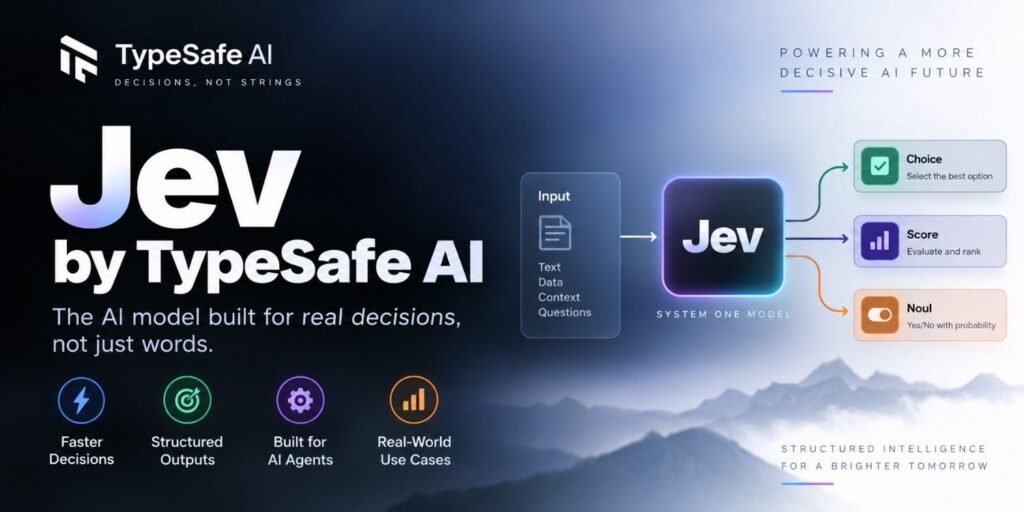
Jev by TypeSafe AI is a new AI model designed for software applications that need fast, structured, and probabilistic decisions. Unlike traditional large language models (LLMs) that mainly generate text, Jev focuses on producing structured decisions that software can use directly.
TypeSafe AI introduced Jev as its first System One Model, designed for fast machine-to-machine decision-making. The technology is particularly relevant to AI agents, automation, classification, routing, scoring, verification, and other applications where software needs to make repeated decisions.
In this article, we will explain Jev by TypeSafe AI, how the Jev AI model works, its decision types, use cases, pricing, API access, and how it differs from traditional AI models.
What Is Jev by TypeSafe AI?
Jev by TypeSafe AI is an AI decision-making model developed by TypeSafe AI. Instead of focusing on long-form text generation, the model is designed to take information about a situation and return typed, probabilistic decisions.
For example, an application could provide Jev with a customer-support request and ask:
- Is the request urgent?
- Which department should handle it?
- Should the request be escalated?
- How risky is the request?
- Which category does the request belong to?
The resulting information can then be used directly by application logic. This is different from asking a general-purpose AI model to generate a paragraph and then attempting to extract a decision from that paragraph.
TypeSafe AI describes this approach around the idea of “decisions, not strings.” You can learn more about the technology on the official TypeSafe AI website.
How Does Jev by TypeSafe AI Work?
Jev by TypeSafe AI is designed around structured questions. A request can provide the model with a state and then ask one or more questions about that state.
The basic concept has two components:
- State: The information that Jev needs to evaluate.
- Questions: The specific decisions that the application wants the model to make.
For example, a customer-service application could provide a support ticket as the state and ask Jev to determine its category, urgency, and whether human intervention is required.
The application can then combine these AI decisions with traditional programming logic. This allows developers to keep deterministic rules in their software while using AI for decisions that require interpretation.
Developers can explore the TypeSafe AI API documentation for more information about the available API and System One functionality.
Jev by TypeSafe AI and System One Models
One of the most important concepts associated with Jev by TypeSafe AI is the term System One Models.
TypeSafe AI uses this term for models designed to make fast decisions within software. The idea is that many software applications do not need an AI model to write an essay or hold a conversation. They simply need an intelligent decision at a particular point in a workflow.
For example, software might need to determine:
- Whether a customer request should be escalated.
- Whether a transaction requires additional review.
- Whether an AI agent should call a particular tool.
- Whether a document belongs to a particular category.
- Whether a security event requires a specific response.
Jev by TypeSafe AI is designed for these types of structured decisions.
You can read TypeSafe AI’s announcement about the technology on its official Jev and System One Models page.
Jev by TypeSafe AI Decision Types
The Jev AI model provides several structured decision formats. TypeSafe AI identifies three important decision types: Choice, Score, and Noul.
Choice
A Choice question asks Jev to select an option from a predefined set.
For example, a customer-support application could classify a request as:
- Billing
- Technical Support
- Delivery
- Returns
- Account
The selected result can then determine which workflow should handle the request.
According to TypeSafe AI, Choice questions can support up to 255 options. Developers can read more about the available functionality in the official TypeSafe AI API documentation.
Score
A Score question evaluates something using an ordered scale.
For example, an application could evaluate support-ticket urgency using levels such as:
- Low
- Medium
- High
- Critical
Scores can potentially be useful for prioritization, risk assessment, lead qualification, quality checks, and automated workflows.
Noul
Noul is designed for yes-or-no-style decisions and calibrated probabilities.
For example, an application could ask:
Is this transaction suspicious?
The resulting probability can then be combined with a threshold defined by the developer. This can allow applications to distinguish between cases that can be automatically processed and cases that require additional review.
Why Is Jev by TypeSafe AI Useful for AI Agents?
Jev by TypeSafe AI can be particularly interesting for developers building AI agents because agents frequently have to make many small decisions.
An AI agent may need to determine:
- Which tool should be used?
- Should a particular action be allowed?
- Does a task require human approval?
- Should an operation be retried?
- Which workflow should run next?
A general-purpose LLM can perform many of these tasks, but a specialized decision model provides another architectural option.
For example, an application could use a general-purpose LLM for complex reasoning and Jev by TypeSafe AI for fast classification, scoring, routing, or decision gates.
This means developers can potentially use different models for different parts of the same AI system instead of forcing one model to perform every task.
Jev by TypeSafe AI Use Cases
There are several software workflows where the Jev AI model may be useful.
Customer Support
Jev can potentially help classify support requests, determine urgency, and route tickets to the appropriate department or workflow.
AI Agent Guardrails
Developers can use structured AI decisions as an additional layer before an AI agent performs an important action.
Content Classification
Applications can classify messages, documents, articles, or other information into predefined categories.
Fraud and Risk Workflows
Structured scores and decisions can be incorporated into workflows where certain transactions or cases require additional review.
Invoice Processing
TypeSafe AI has published an invoice-processing example demonstrating how independent decisions and programmatic rules can be combined in an automated workflow.
You can explore the TypeSafe AI invoice-processing evaluation for an example of this approach.
Security Workflows
AI decisions can also be incorporated into security workflows. TypeSafe AI has published a security-incident workflow example demonstrating this type of application.
You can view the TypeSafe AI security incidents evaluation for more information.
Jev by TypeSafe AI vs Traditional LLMs
One of the biggest differences between Jev by TypeSafe AI and traditional LLMs is the type of output they are designed to produce.
| Feature | Traditional LLM | Jev AI |
|---|---|---|
| Primary purpose | General generation and reasoning | Structured decisions |
| Output | Generated text | Typed decisions |
| Typical applications | Chat, writing, coding, reasoning | Classification, routing, scoring |
| Software integration | May require parsing | Designed for structured integration |
| Decision confidence | Depends on implementation | Designed around probabilistic decisions |
This does not mean that Jev by TypeSafe AI is intended to replace every general-purpose LLM. The two technologies can be used together for different parts of an application.
A general-purpose model can handle complex reasoning while Jev handles smaller, repeated decisions.
Jev by TypeSafe AI Pricing and Speed
TypeSafe AI currently lists Jev’s input pricing at $42 per billion input tokens, equivalent to $0.042 per million input tokens. TypeSafe also states that output tokens are free.
The company also publishes latency information for its service. These figures should be understood as company-reported measurements rather than independent benchmarks.
Because pricing and service specifications can change, developers should check the official TypeSafe AI website for the latest information before integrating Jev.
Is Jev by TypeSafe AI Better Than ChatGPT?
It is more useful to think of Jev by TypeSafe AI and general-purpose AI models as technologies designed for different tasks rather than direct replacements for each other.
General-purpose LLMs are useful for:
- Writing
- Conversation
- Coding
- Summarization
- Open-ended reasoning
- Creative generation
- Complex explanations
Jev focuses more specifically on:
- Classification
- Routing
- Scoring
- Verification
- Decision gates
- Automated workflows
A software application could therefore use different models for different jobs.
For example, an LLM could understand a complicated user request while Jev could determine which predefined workflow should execute next.
Is Jev by TypeSafe AI Open Source?
Jev by TypeSafe AI is currently presented as a hosted AI service that developers can access through an API. It is not presented as a downloadable open-source model with publicly available model weights.
Developers interested in integration can consult the official TypeSafe AI API documentation for the latest technical information.
What Makes Jev by TypeSafe AI Different?
The biggest difference is the interface.
Traditional AI models generally communicate through generated language. Jev by TypeSafe AI is designed to communicate with software through structured decisions.
This distinction can be important when predictable schemas, probabilities, latency, and automated workflows matter.
The basic workflow can be thought of as:
AI decision → confidence → application rule → automated action or human review
Instead of giving an AI model complete control over an application, developers can keep the surrounding workflow under programmatic control.
Future of Jev by TypeSafe AI
The development of Jev by TypeSafe AI highlights an important direction in AI: not every AI task requires a chatbot or a long generated response.
Modern software contains thousands of decisions. Applications need to classify information, prioritize tasks, determine risk, route requests, select tools, and decide when human intervention is necessary.
A specialized decision model such as Jev provides another possible architecture for handling these tasks.
As AI agents become more common, structured decision-making could become an increasingly important part of application design.
Developers may combine large generative models with specialized models that handle individual decisions inside automated workflows.
Conclusion: Jev by TypeSafe AI Explained
Jev by TypeSafe AI is an AI model focused on structured decision-making rather than traditional conversational text generation.
The model is built around structured decision types such as Choice, Score, and Noul. These can be used for classification, scoring, routing, verification, and other automated software workflows.
The main idea behind Jev by TypeSafe AI is to make AI decisions easier for software to consume. Instead of relying entirely on generated text, developers can use structured AI outputs as part of normal application logic.
For developers building AI agents, automation systems, and software workflows, Jev represents an interesting approach to integrating machine intelligence directly into application logic.
You may Also Read: GPT-6 Astra: Features, Pricing, Release & More
Frequently Asked Questions About Jev by TypeSafe AI
1. What is Jev by TypeSafe AI?
Jev by TypeSafe AI is a System One AI model designed to make structured, probabilistic decisions that software can use directly.
2. What is Jev AI used for?
Jev AI can be used for classification, routing, scoring, verification, AI-agent guardrails, customer-support workflows, security workflows, and other automated decision-making applications.
3. What are the Jev decision types?
The main Jev decision types are Choice, Score, and Noul. They are designed for selecting options, assigning ordered scores, and making calibrated yes-or-no-style decisions.
4. Is Jev by TypeSafe AI a replacement for ChatGPT?
No. Jev by TypeSafe AI is designed around structured decisions, while general-purpose LLMs are designed for a much broader range of tasks such as conversation, writing, coding, reasoning, and content generation.
5. How can developers use Jev by TypeSafe AI?
Developers can access Jev through TypeSafe AI’s API. The official TypeSafe AI API documentation provides information about available endpoints and supported decision formats.